Director Work
This section details the work that was related to my role at the Director level - primarily focused on front office work.
As noted on other pages in the portfolio, a significant amount of work was done as a Director in the areas of Analytics, Scouting, and Rehab - none of which are in this portfolio, but available for comment and discussion in an interview setting.
Addressing Depth of Pitching
At the end of the 2019 season, by Expected ERA (xERA), the Cincinnati Reds MiLB pitching as an organization ranked 25th out of 30 teams at 4.21, with the average organization turning in a 4.07 xERA. Public analyst Matt Collier had a more stark view on the Reds minor league pitching system, ranking it the worst organization in all of baseball by his system's output.
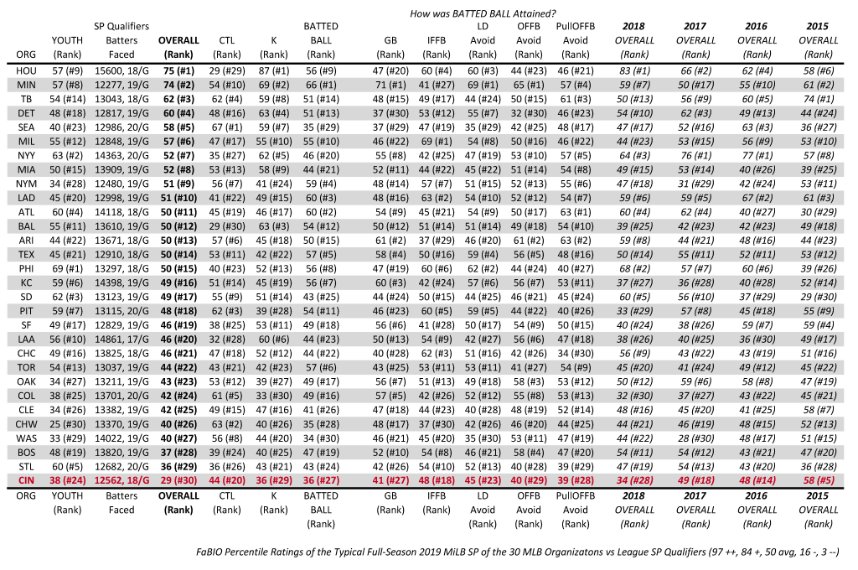
This was our largest task in front of us, so I will outline it first as a high-level overview here, with details on how we made it happen to follow both in this section and in more granular terms in the Projects Completed section of the navigation bar of this portfolio.
A significant contributor to this problem was the underwhelming depth of the system and existing overaged players at the full-season levels. Reviewing the Fangraphs Board of pitching prospects at the beginning of the 2020 season, the Reds had a below-average number of pitching prospects and would go on to drop two 35+ FV players (Ryan Hendrix promoted, Jose Salvador traded) and four 40 FV players (Tejay Antone promoted, Vladimir Gutierrez promoted, Packy Naughton traded, Noah Davis traded) from our minor league prospect list for a total reduction of six prospects from our already-thin ranks of depth. The looming promotions of other 40-50 FV talent hung over our heads in Tony Santillan, Graham Ashcraft, Hunter Greene, and Nick Lodolo - a great problem to have, but one that threatened to put a large hole in our flow of prospects that could expose a 1-2 year window down the line where we have little to no major league ready talent available at the higher levels. As a mid-small market team, we needed to fill holes in the major league roster with homegrown cost controlled talent - free agency would not be a viable way to continue to keep a competitive team on the field.
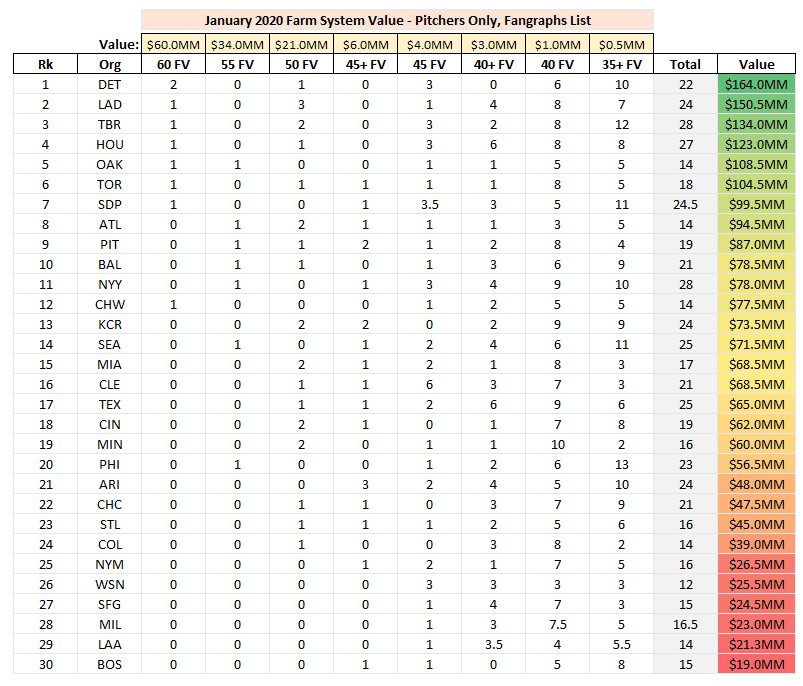
A lack of depth is an obvious issue regarding adequate replacement level talent on its face; its secondary effects force organizations to trade from their premium stock in deals for major league talent, limits the ability to develop marginal players into 50 FV or better talent, and puts the system at risk for single-point failure due to a top-heavy distribution. A robust and antifragile system should benefit from volatility, and the way to do this is to stockpile the lower levels with talent that can credibly become 35+ FV talent or better. This area had to be addressed quickly.
Our strategy to rapidly bolster the farm system was multifaceted:
- Implement an individually-based risk-adjusted training program organization-wide by appropriately assigning programs with higher-risk, higher-reward outcomes on players who had limited projection
- Put a strong focus on developing relievers aggressively, who can move faster and thus be available on a quicker timeline
- Aggressively pursue niche minor league free agents that fit our system
- Promote players faster than we had previously considered
Once we were all sent home during the 2020 Spring Training period, it became quickly apparent to me that we would not likely play any games during the minor league season. Eric Lee and I defined three Key Performance Indicators heading into the 2021 season, which were as follows:
- Improve organizational-wide fastball velocity
- Improve organizational-wide strikeout rate
- Improve farm system rankings
As the pandemic year began, we were afforded two new opportunities: A period where we had no games, and thus could focus solely on training and pure output, and the non-drafted free agency period in the amateur draft. In the interest of being as brief as possible with details to follow, our department achieved all three results at the end of the 2021 season.
- Fastball velocity went from 91.2 MPH (rank 11) to 92.0 MPH (rank 4)
- Strikeout rate went from 22.2% (rank 22) to 25.3% (rank 4) from 2019 to 2021
- Farm system rankings went from bottom 10 to top 10 by Baseball America
Achieving the results we wanted would have to go beyond improving fastball velocity; we had to improve our overall stuff. For this, we used Stuff+, a metric that Driveline Baseball first developed and has later been emulated across professional baseball and has gotten some traction in the public sphere. 100 is league-average, 95 is 5% worse than league average, and 107 is 7% better than league average - just like Weighted Runs Created and other Plus-Scale metrics. The inputs on Stuff+ are swing and miss, suppressing damage on contact (xwOBAcon), and other components of preventing runs via predictive characteristics of ball physics data; both the Reds internal model (developed by the same person who developed the Driveline Stuff+ model, Dan Aucoin) and the Driveline model explain a significant amount of variance around xERA, RA9, and other run estimators.
I spent the months leading up to the 2020 season reskilling our pitching coaches and orienting their output around Stuff+ and other process-based metrics, which was a large shift in organizational mentality. When the pandemic training period occurred, we set up a robust system to stay in contact with our players via Slack channels and scheduled group Zoom calls with mandatory video uploads and other participatory events. Ultimately, we felt confident that coaching our players asynchronously would yield large gains, especially after the 2020 draft and the large crop of NDFAs we brought in-house. The pre-draft 2021 Stuff+ organizational rankings would tell the final tale:
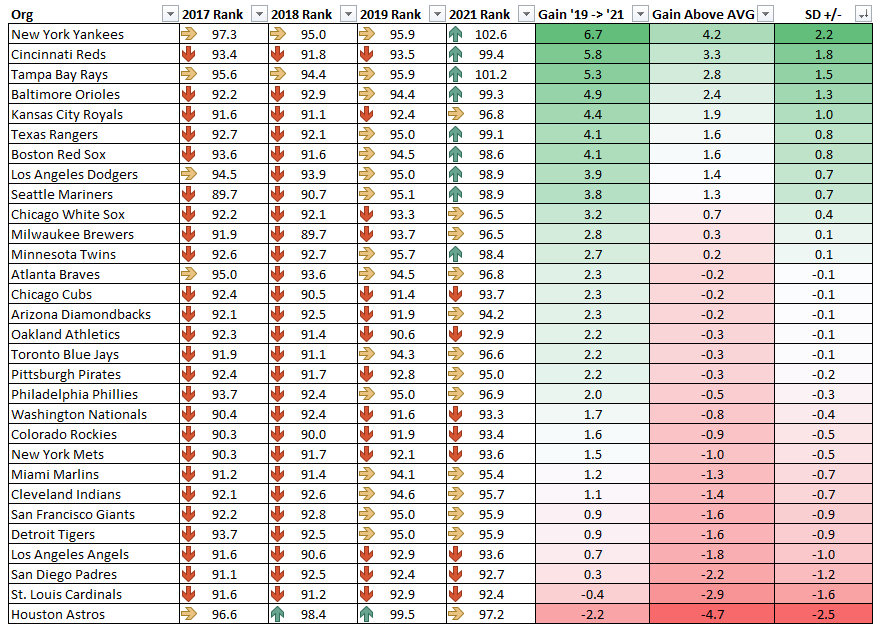
When combining breaking balls and fastballs (chart above), the Reds finished 2nd in Stuff+ Gained, which elevated the organization to overall 3rd best MiLB Stuff+, up from 18th. By fastball Stuff+ alone, we had the largest year over year gain.
How it would play out on the field would be the ultimate test, and we passed there as well - in 2019, the Cincinnati Reds MiLB pitching ranked 25th in xERA (4.21 xERA, 14 points worse than league average), while at the end of 2021, the Reds MiLB pitching ranked 6th best in xERA (4.16 xERA, 19 points better than league average).
In 2021, the Reds also had the first overall combined win/loss record over .500 in the minor leagues since 2011 and the highest winning percentage since 2006 - so not only were we developing stuff and high predictors of getting outs at the next level, we were winning games while doing so.
Furthermore, we saw excellent results in our upper-level prospects - promoting Hendrix, Santillan, O'Brien, and Sanmartin to the big leagues and seeing tremendous growth in Hunter Greene, Nick Lodolo, and Graham Ashcraft, all players we expect to see jump considerably upwards from their 2020 and 2021 rankings - to say nothing of the numerous breakout pitchers at the Low-A to Double-A levels.
The training had worked and proven successful through a combination of relentless coaching, holding players and staff members accountable for their work product, technology-based initiatives to set objective key results, and a highly-educated staff and player base who knew what leadership wanted and how to develop it.
The depth of the minor league pitching system had been rebuilt in just two years.