Coordinator Work
This section details the work that was related to my role at the Coordinator level - primarily focused on the on-field product as well as our coaches.
Standardizing a Communication Platform and Methology
The Player Development side of the Cincinnati Reds did not have standardized communication - we had an Enterprise Slack account, but only the Analytics and Scouting departments seemed to use it. Emails were used for player moves, but phone calls at all hours of the day could happen for moves that would normally happen over email. Texts were exchanged with some people, except for those who were in Latin America, where we used WhatsApp - some of the time, anyway. This problem exists in most baseball organizations, and it created chaos, missed messages, and frustration at every level. I had gone through this before when standardizing communication channels at Driveline Baseball, and knew the path forward was marginally painful but would create a lot more clarity.
All four sections under the Pitching Coordinator changes have the same three philosophical roots, and standardizing communication platforms and channels is no exception - it is always the first thing to tackle as a new leader, as all initiatives depend on clear, concise, and specific lines of communication:
- Empower your direct reports by investing in continuing education and participating in relentless training/upskilling
- Move towards a leader-leader structure - in most cases, that involves moving away from a leader-follower structure
- Finally, create a culture of accountability by clear objectives that relies on the continuing education, and very little else (no gotcha moments)
We settled on the following hierarchy of communication standards, in order of preference:
- Slack: Used for real-time communication with staff AND players; messaging that required < 24 hours of response time.
- Email: Used for official reports, player moves, and information that had a broader audience (the front office were not avid Slack users).
- Phone Calls: For emergencies only - injuries, roster decisions that had deadlines, disciplinary issues that couldn't wait, etc.
- Text Messages: Never. Use Slack. Staff members were instructed to ignore all text messages related to pitching and direct all communication over Slack.
- WhatsApp: Never. Use Slack. Staff members were instructed to ignore all WhatsApp messages related to pitching and direct all communication over Slack.
The adjustment period lasted a few weeks, as coaches would text/call outside of the lines above, and would be gently reminded about the communication policy and to please abide by them. The grumbling was present to begin with, but once all communication was centralized inside Slack, people understood the value of having a central channel (we called it #armsrace) for communication, with multi-user DMs for breakout sessions. We also had every player join a separate Slack Workspace, created training group channels named after Cincinnati Reds legends during the pandemic, and team channels when the 2021 season got underway - #tortugaspitching, #dragonspitching, etc.
The players loved this - no more WhatsApp, text, Instagram fragmentation. One place to talk to your team, view your postgame reports, weekly advance reports, and plenty of trash talking amongst the minor league teams in channels like #general and #videoshare (where coaches uploaded weekly "best of" clips, sometimes cleverly edited together). We also had #socialmediafinds for sharing interesting social media clips (often from @PitchingNinja) and #fah (fearlessly attack hitters... or... you know...) where coaches posted their postgame charts with a scoring system that Eric Jagers called the "FAH Chart" (inherited from Derek Johnson's motto on the big league team). This initiative took a LOT of effort to get right, but was extremely rewarding, especially when we tied in our other educational initiatives with them.
Instilling Organizational Guidelines for Pitchers
By the end of my two year contract, I needed our coordinators, coaches, and players to all be able to answer this question clearly and with strong consensus:
What does it mean to be an ideal pitcher for the Cincinnati Reds?
When I took over as the Pitching Coordinator, I asked all of the coaches this question as well as many of the players. The answers were all over the place, but the majority of them were simply "I don't know." What our identity would ultimately become needed to be a collaborative process, not dictated by leadership, but it definitely needed to become consistent. We already had an organizational doctrine in place called ACR, standing for Authentic, Connected, and Relentless - so the pitching department's task was to integrate our message inside that framework.
Authentic was straightforward - we set a policy of telling the truth early on, and when Bryan Conger joined the organization in 2021, he pushed this concept further with his Table of Truth ideas and regular small group settings with high trust factors. When we could not tell the truth due to being in an organizational bind, we told the players that we couldn't tell them exactly why something was happening - we could at least do that for them rather than lie to them. We were upfront with our players on why they were promoted or weren't considered for promotion, we told them why they were being sent to Extended Spring Training, and when players were released, they knew what the performance-based reasons were. Players came to truly appreciate this about our organization and structure, and many asked why it wasn't this way before or why it's not this way in other organizations.
Connected was tougher, and we settled on doing so by implementing the clear communication doctrine laid out about using Slack as our central hub for discussion. We set standards for how we communicated, when, and critically, what the players were owed by the coaching staff. This turned the idea that players owe coaches on its head; I explicitly told the players that there were expectations for our coaches, and that the players needed to hold the coaches accountable starting with clear, concise, and authentic communication.
Relentless: To quote Dan John, "it's simple, not easy." We could not start with the players on this topic, we had to start with our staff. There is no way to expect relentless competition from the players if you're arriving to the park at the same time the players do and leaving when they leave. This is something I learned early on with the Houston Astros by accident - while they had no design for this type of organizational culture, the front office's extremely high expectations for their coaches filtered down, and I've never forgotten how the players responded to that. When I took the job with the Reds, our coaches had not yet signed contracts for the following season (2020). I told our coaches that we would outwork every other group in minor league player development, and that if that wasn't for them, they didn't have to sign their contracts - but that if they did, I would be holding them accountable for everything in the job description. The culture of the Reds' player development group prior to CJ Gillman and I taking over our respective departments was not one of relentless execution and excellence in everything we did, and both of us set to change that in our own ways.
Perhaps a simple example illustrates all three concepts quite well. It was feared that I wouldn't care about the little things in the game, such as holding baserunners to control the running game. Despite this belief, up until the last week of the AAA season, the 2021 Cincinnati Reds minor league pitchers were ranked 1st in Weighted Caught Stealing (wCS), meaning that we allowed the least stolen base run value. At the end of the season, we finished 2nd overall in wCS, while in 2019 we had finished 20th. Nothing about our catchers' throwing changed, so the vast majority of the value generated was from the pitchers caring about holding baserunners. Our coaches trained anti-run game doctrine hard, they posted times to the plate weekly in Slack, and periodically reviewed video to ensure no patterns were coming out. We took pride in being 1.35s or better to home plate every time, and we did not accept 1.4s or worse. The gold standard was to be below 1.3s to home plate with a runner on 1st base every time, and most of our players reached it. To be sure, holding runners is just a small part of the game, but it encapsulates being relentless to me - we should aspire to be great at everything we do.
We also set Key Performance Indicators (KPIs) early on - we wanted to turn around the ship on our falling organizational strikeout rate (Rank 22nd in 2019) and our very high organizational xwOBAcon rates (Rank 23rd in 2019) first and foremost. I knew that developing stuff, strikeouts, and reducing damage on contact would cause us to walk more hitters as the pitchers learned to adapt to this new strategy, and indeed our walk rate swelled as an organization in 2021. I also understood that was part of our multi-year process, much as it was with organizations that began this transformation towards a data-driven approach - the same early growing pains happened with the Houston Astros and Minnesota Twins, and I knew it would happen here. Our pitchers turned around a culture of "just throwing strikes" and "learning to pitch" (we eliminated this type of non-specific and negative language in our coaching doctrine) and turned it into a positive culture of dominating hitters, never giving in, and attacking with our best stuff at all times.
Only the players can tell you if you've achieved a common set of core values, so I'll let them have the final word - I asked them one simple question.
What does it mean to be an ideal pitcher for the Cincinnati Reds?
- Jared Solomon (40-man, 2017 draft): "What it meant to be a Reds pitcher in 2021 is to have an unyielding desire to better yourself. Not just on the mound, but in everything we do, because we as an organization have made it clear that all our individual pieces throughout a day, week, month, and year lead to our final results when we take the mound. We had a clear plan and mission everyday; we communicated that plan and what was expected so there wasn't any room for 'Why are we doing this?' We had the data to back up the 'why' - it gave the players confidence to buy in and to take the risk; to be willing to change to be better."
- Noah Davis (2018 draft, traded to COL in '21): "The ideal Reds pitcher develops nasty stuff and shoves it down the hitters throats. He is consistent, reliable, and durable. He has a plan and executes that plan, both on a short-term and long-term basis."
- Carson Spiers (Clemson, NDFA, 2020): "Being a Cincinnati Red meant being held accountable and focusing on every throw to make sure we are getting 1% better each day."
- Stevie Branche (RIT, NDFA, 2020): "An ideal Reds pitcher is someone who is constantly going to be aggressive every pitch that they throw and to compete each time he is given the ball. They will not stop focusing on perfecting their craft."
- Braxton Roxby (U. Pitt-Johnstown, NDFA, 2020): "Our process involved breaking down the game as much as possible, prioritizing winning each inning, at-bat, and pitch. We understood that in order to prevent runs and limit damage, we had to buy into the small wins."
- Bryce Bonnin (Texas Tech, 3rd round, 2020): "We become motherfuckers on the mound."
Defining Standards for Coaching Excellence
Upon taking the Pitching Coordinator role in Cincinnati, I audited all of the previous standards, practices, and guidelines put into action by asking the outgoing coordinator (Tony Fossas), ML Pitching Coach (Derek Johnson), Director of Pitching (Caleb Cotham), Farm Director (Eric Lee), and President of Baseball Operations (Dick Williams) about how things were run and what principles were important to the organization. The ACR doctrine came out in 2019, which I felt was a great guiding light on how we should act as an organization from the front office to the field, however, details on what we stood for as a pitching department were thin or didn't exist at all. No standards, metrics, or objective key results were written down or set.
I decided to review the last two years' worth of performances from the organization's minor league pitching to see if results would leave clues, and a picture began to form:
Reds Minor League Pitching Organizational Ranks (out of 30)
2018 Season
- xERA: 25th
- ERA: 28th
- Strikeout Rate: 22nd
- Walk Rate: 14th
- Hits Allowed Rate: 26th
- WHIP: 27th
- xwOBAcon: 27th
- Whiff Rate: 26th
- Putaway Rate: 30th
- Weighted CS: 28th
- Fastball Usage Rate: 10th
2019 Season
- xERA: 25th
- ERA: 27th
- Strikeout Rate: 22nd
- Walk Rate: 9th
- Hits Allowed Rate: 28th
- WHIP: 27th
- xwOBAcon: 23rd
- Whiff Rate: 26th
- Putaway Rate: 27th
- Weighted CS: 20th
- Fastball Usage Rate: 13th
2018 Season
- xERA: 25th
- ERA: 28th
- Strikeout Rate: 22nd
- Walk Rate: 14th
- Hits Allowed Rate: 26th
- WHIP: 27th
- xwOBAcon: 27th
- Whiff Rate: 26th
- Putaway Rate: 30th
- Weighted CS: 28th
- Fastball Usage Rate: 10th
2019 Season
- xERA: 25th
- ERA: 27th
- Strikeout Rate: 22nd
- Walk Rate: 9th
- Hits Allowed Rate: 28th
- WHIP: 27th
- xwOBAcon: 23rd
- Whiff Rate: 26th
- Putaway Rate: 27th
- Weighted CS: 20th
- Fastball Usage Rate: 13th
To me, these statistics spoke pretty loudly that.... it wasn't clear what this organization valued. The walk rate was too high for a team that cared about "controlling the zone" like the Seattle Mariners do (regularly have an elite walk rate in the minor leagues), the strikeout rate was far too low to consider it a key metric like the Houston Astros do, and the pitch type usage rates were all over the place, indicating no consensus way to develop the skill of missing bats and attacking hitters like the Minnesota Twins employ (high breaking ball use at the lower levels).
Simply put, there was no flag planted in the ground on what we were trying to be great at, except "pitching," and goals that are overly-broad simply don't work. The blended xERA being so poor also indicated that the "organizational" or "non-priority" pitchers (two terms I don't believe in, but are unfortunately industry-standard) were not getting enough coaching, and we were likely missing out on a lot of value as a result.
Outside comments from scouts and coaches in other organizations told me that I was inheriting a bad farm system, and they wished me the "best of luck." True, after the expected losses to our farm system via trades and promotions, the organization was exceptionally shallow in pitching depth, was poorly-ranked by both Baseball America and Fangraphs, and Matt Collier (FaBIO system) said it was the worst in all of baseball, but I felt that the talent was likely both being used incorrectly and wasn't being developed to its fullest potential.
I watched (and participated in) the reformation of the Luhnow-era Houston Astros minor league player development system (ranked dead last, along with their major league talent rankings), and had a good idea where to start: Setting a strong identity, concrete long-term Objective Key Results (OKRs), and short-to-mid-term Key Performance Indicators (KPIs). We would hold our staff accountable to these concepts, and tell the players that not only would we hold them accountable for these metrics and that we would coach them how to achieve them, but also that they should hold our coaching staff accountable for helping them achieve the results we sought as an organization. By putting the players in a leader-leader orientation with the coach, we sought to develop servant leadership, a tenet that Bryan Conger would take to the next level.
Ultimately, by holding our coaches accountable to a set of guidelines we believe in, and building an identity players could stand behind and point to as their North Star, we succeeded in building a culture of servant leadership and excellence in everything we did. We held each other to high standards and pushed players and staff to achieve greatness - a word we used often. Most importantly, we did it collaboratively - not in a leader-follower sense, but a leader-leader sense. My role was to insist on excellence and to kickstart the process, but the metrics we ended up choosing and the language we evolved to describe our processes came out of meetings with our players, coaches, and other staff members in the organization to own it together as a group, through conflict, resolution, and ultimately, unity.
As said multiple times earlier on this page, we went from the 25th ranked organization in xERA to the 6th ranked organization in just two years. We've discussed how we did it from a cultural standpoint; now here's the statistical components that improved to generate that systematic improvement:
2021 Season
Improvement: Regression:
- xERA: 6th
- ERA: 7th
- Strikeout Rate: 4th
- Walk Rate: 28th
- Hits Allowed Rate: 3rd
- WHIP: 11th
- xwOBAcon: 3rd
- Whiff Rate: 4th
- Putaway Rate: 7th
- Weighted CS: 2nd
- Fastball Usage Rate: 26th
Developing Educational Resources to Upskill Coaches
Holding direct reports accountable for clearly-set standards sets them up for failure unless you devote at least as much time developing educational resources for them to achieve the lofty goals you set for the department. High Output Management - widely considered one of the best books on management - discusses this concept at length. A simple concept from the book that has stuck with me for years:
Training is the manager’s job.
Training is the highest leverage activity a manager can do to increase the output of an organization. If a manager spends 12 hours preparing training for 10 team members that increases their output by 1% on average, the result is 200 hours of increased output from the 10 employees (each works about 2000 hours a year). Don’t leave training to outsiders, do it yourself.
Training our staff was the second most important thing to get right after planting our flag in terms of OKRs and KPIs that we cared about - and all training should stem from the North Star of the stated goals of the department. The staff I inherited had very little familiarity with progressive coaching methods, but a one-size-fits-all training program wouldn't succeed because I also brought in progressive coaches to fill vacancies. The way that we developed our training platform was to participate in regular round robin continuing education sessions - we would have the coaches with signficant major league playing experience who had also been with the organization for a long time - and thus knew all the players - talk about their rich history in the game, how they felt it applied to their coaching strategies, and talk about the players' backgrounds, issues, and give their evaluations. We did not have a centralized player development application where notes were kept over the years, so a lot of this knowledge was simply tribal and lived in the heads of the coaches and staff members of the Cincinnati Reds - therefore, legacy coaches could contribute massively by simply telling stories and getting it all documented in a distributed system while we waited for the official player development application to be finished (we used Google Drive for this).
While the legacy coaches built up the whole staff in terms of lived experience and started filling in the gaps for our new coaches, Eric Jagers and I began work on developing a comprehensive training platform to both build the skills we'd expect from our coaches and to build a common language in our organization; the latter point was Eric's biggest point he continually hammered home. I developed a simple content management system (CMS) built on top of WordPress, password-protected so only our coaches had access to it, and began fleshing out the categories.
Ben Horowitz (author of The Hard Thing About Hard Things, one of my favorite books on management) wrote an essay in the late 1990s when he took over a failing company with the intention of turning it around: Good Product Manager / Bad Product Manager. I've used this document's concept at several companies I've worked at and found it exceptionally powerful; it clearly outlines what a good employee does, and what a bad one does. It sets the standard and makes it crystal clear - and you go over it both in written form as well as a single, concise meeting where every direct report signs off on it. Ironically, the difficult part after the document has been circulated is simply keeping your word - suddenly, it is the manager's responsibility to ensure he means what he says in a document like this!
For the Cincinnati Reds, I used the same template, delivering a three-page document titled Good Coach, Bad Coach. Some of the bullet points were:
- A good coach executes an agreed-upon player plan because he is fully bought into the Cincinnati Reds pitching development system from top to bottom. A bad coach goes off-script because he thinks he knows best.
- A good coach uses concise, consistent language when describing mechanical concepts. A bad coach uses verbiage that’s difficult to interpret and may confuse players and support staff.
- A good coach sets the strategy in catch play, throwing drills, and bullpens ahead of time and limits the discussion during the actual activity. A bad coach over-cues the athlete during the competitive event, which confuses them and reduces their independence.
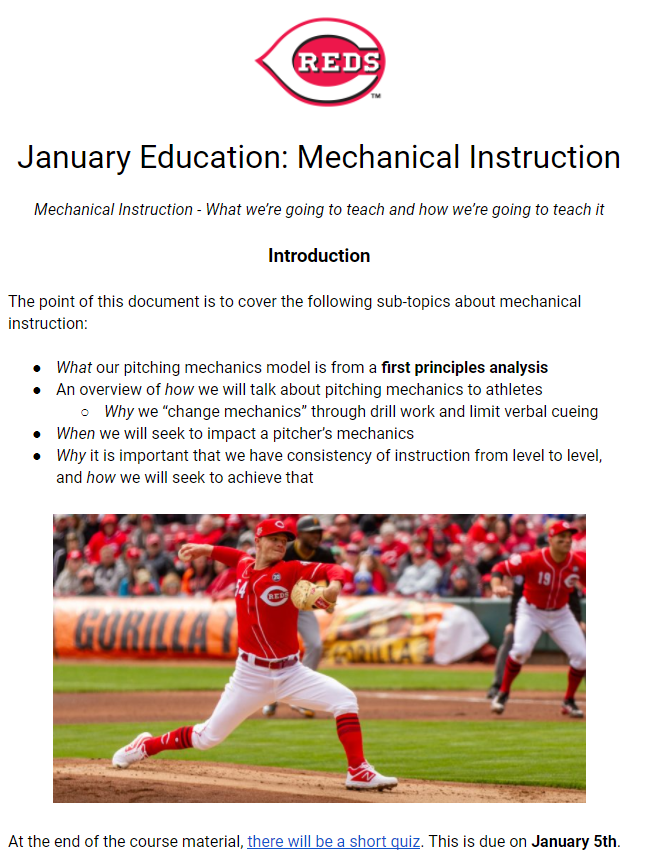
We also held a "Pitching Summit" in January 2020, prior to showing up to Spring Training. In anticipation of this event, I prepared four mini-courses and quizzes to be completed prior to showing up to the summit. This way, we'd all be on the same page regarding content.
Mechanical Instruction Course
Quiz for Mechanical Instruction
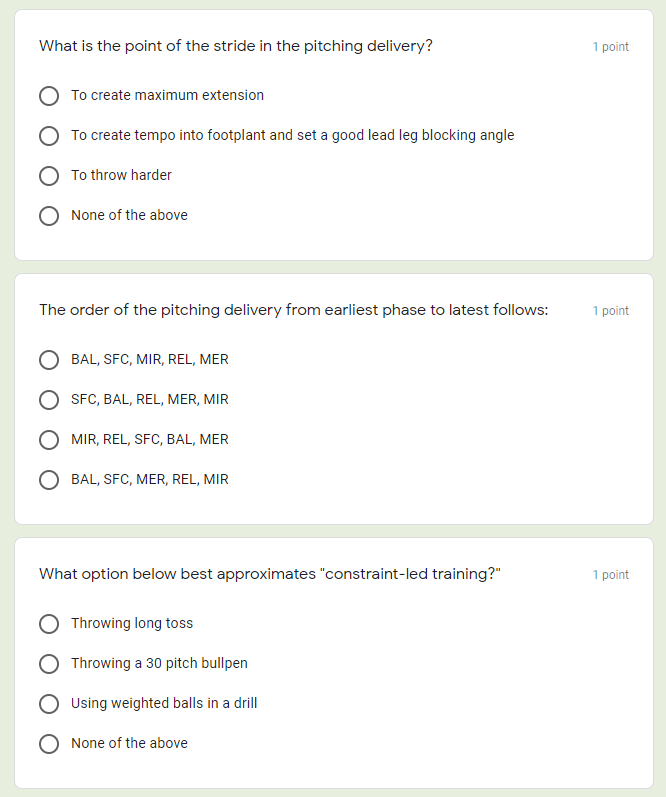
The grades on the quizzes were not too encouraging heading into the summit, with the inherited coaches doing quite a bit worse than the new coaches - directionally, this is what I expected, but it was also clear that the inherited coaches were not necessarily taking the assignments entirely seriously. Eric Jagers and I decided to take a hands-on approach at the event while keeping the mood positive in the room. We addressed the fact that today's player - especially college-educated ones - come to expect this type of analytical coaching, and that they're going to get it from somewhere, so it must be part of who we are. We led in-person TruMedia "scavenger hunts" to work in real-time, collaboratively on teaching the group how to use the site to run basic reports and learn more about their own players, which ended up being a pretty strong hit.
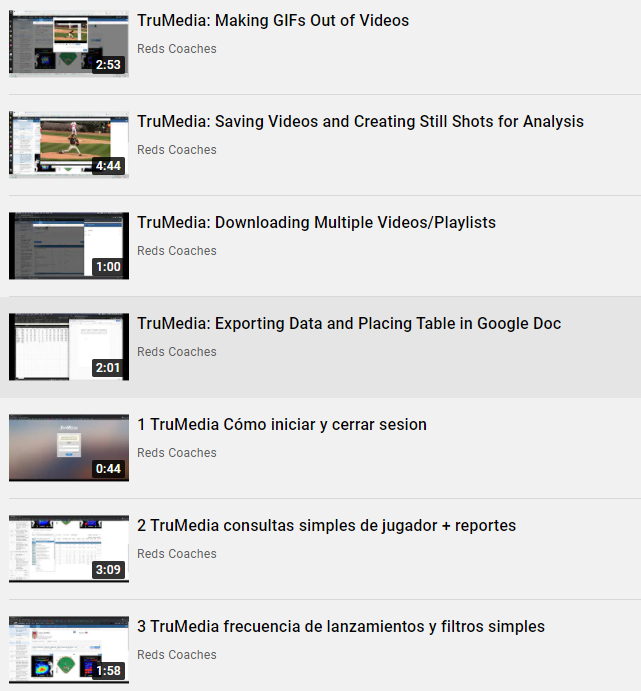
Many coaches who saw a lot of value of the interactive TruMedia session were worried they'd forget it all once they went home, so I produced a number of screen-recorded videos with both English and Spanish voiceovers (paid a friend who is a baseball translator to do this for me) and uploaded them to our department's private YouTube channel:
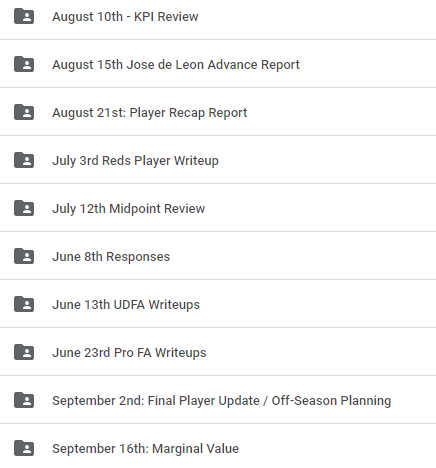
As the pandemic hit and we were coaching remotely, we kept up continuing education assignments and regular Zoom meetings. Having managed a remote team before, I realized that consistent engagement and clear standards were important to keep everyone engaged, productive, and locked-in. A sample of our assignments throughout the year follows:
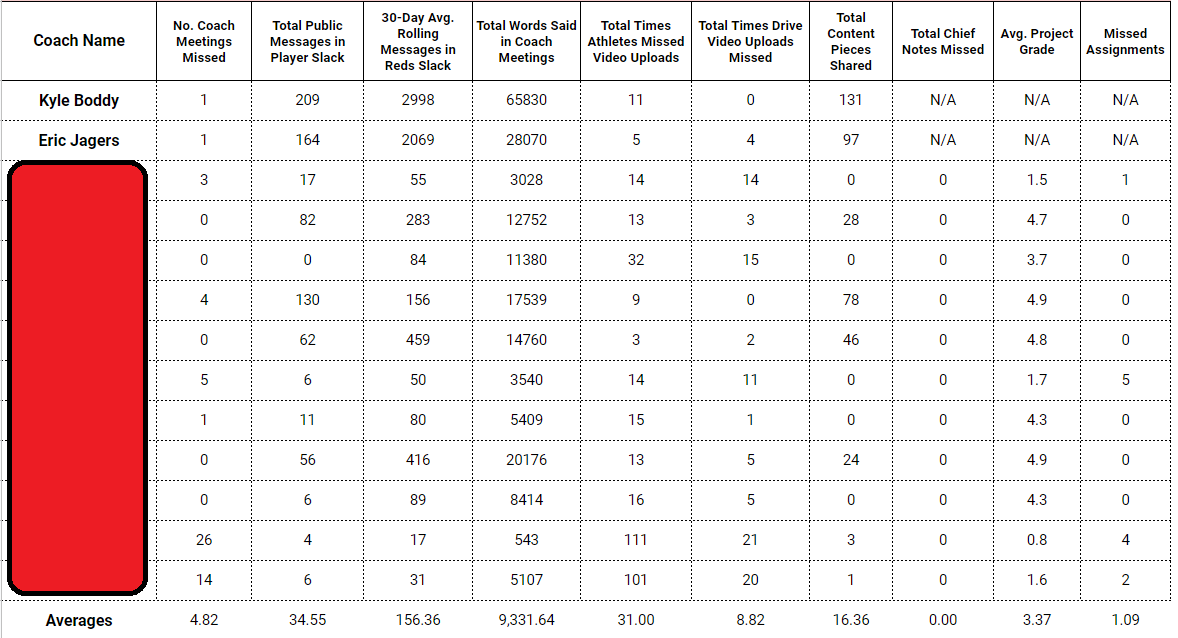
As the pandemic year came to a close, we got word that we'd be cutting two short-season affiliates (Greeneville and Billings), Caleb Cotham would take the Philadelphia Phillies ML pitching coach job, and Eric Jagers would be promoted to fill the Assistant ML Pitching Coach position, with me taking the Director of Pitching role. It came time to make some staffing changes, and one piece of information that allowed me to make suggestions to the front office on how to improve our staff was a tracking sheet I had been developing throughout the year, which had a number of objective metrics on it, like how many meetings coaches missed, if their athletes were missing video uploads, even things like how many words were spoken in a Zoom meeting (we had automatic recording and transcription software for archival purposes).
No one metric defined who we would non-tender, keep, or promote, but having a wealth of objective information helped guide a process-driven decision tree in what is always a tough situation. Not only did this allow us to make the best decisions for the organization, but having very documented metrics (including a staff interaction log between coordinators and coaches) also benefited the Human Resources department and helped protect them from potential liability heading into employee separation discussions.
Developing an elite staff of coaches unfortunately involves separation, no different than building the best pool of players - especially under the new domestic cap of 180 players in the minor leagues. Making tough decisions via data-driven methods gives employees a specific set of guidelines along the way, with clear standards set and managers who consistently check in with their direct reports on topics like continuing education and player progress.